
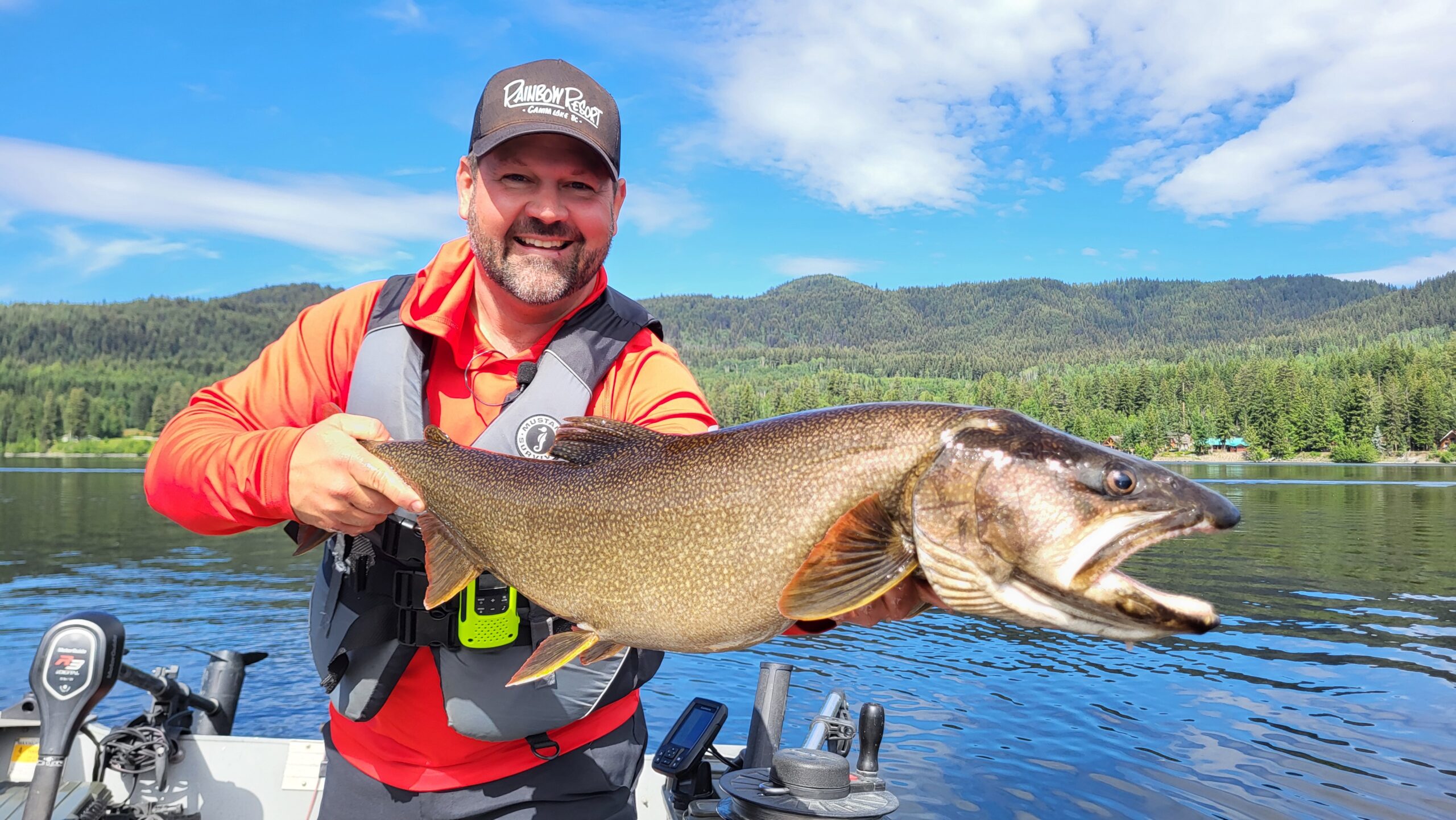
Family, friends, and fishing are three of my favorite things in life. When you combine all these three things at once, magic happens. I love sharing my passion with others through my YouTube channel, and website and magazine articles. When my family and friends join me, the experience I have is elevated to a new level of happiness. Learning becomes more engaging when we can get together and talk about the day and what we learned and want to try next. Not to mention, the fun games we play on shore, the stories told around the campfire and the new people we meet along the way on our adventures are the icing on the cake.
Our most recent family and friend’s adventure brought us back to Canim Lake. This was our third year returning to Rainbow Resort. We love this resort because it feels like home. The hosts Taylor and Shay are amazing, and always help keep our stay as comfortable as possible. I enjoy the friendship that has been created over the years, and I look forward to many years ahead. We also met many people on our last trip that have watched my YouTube channel, Fougere Family Adventures, and they made an effort to introduce themselves and talk about fishing. Moments like these are inspiring and help give me the energy to continue making videos to help others learn. I appreciate everyone taking the time to talk fishing with me, because as you know, once you get me started it is hard to walk away during a good fishing story.
We booked our stay the same week as last year because the fishing was decent, there was no campfire ban, and we wanted to learn more about lake trout during the late spring season. Fishing on Canim lake can be tough most of the time and I was intrigued to see if I could unlock the secret to catching lake trout in tea-stained lakes with limited visibility. When we arrived, I noticed that the water was a lot clearer than last year. During our week stay the water clarity improved even more, which was a noted experience. The lake levels were lower this year than last year and the mild winter with minimal snowpack seemed to be a contributing factor to the lake chemistry.
The time we arrived on the calendar was the same as last year, but the seasonal progression of events was different. Last year, we witnessed extreme pollen floating on the lake over low water visibility conditions. We also experienced cotton floating in the air like it was snowing. This year, the pollen and cotton had already come and gone. I find it interesting and worth noting that there appeared to be a correlation between these seasonal cues and the depths we were finding the lake trout at. I believe that following mother nature and watching for her clues can help us be successful as anglers. I follow this belief when it comes to fishing for kokanee on my local lake, Ten Mile Lake. When my lilacs bloom in my yard I know the water temperatures have warmed up enough and the kokanee are biting more readily. This year on Canim proved to be another learning curve. While we missed the pollen and cotton, we experienced the mayfly hatch.
As my boys grow older, I love watching them choose their direction in life. This year, we attended some fly tying get togethers and before I knew it my boys were dusting off my twenty-year-old fly rods and digging out my old Simms wading vest full of flies. I have enjoyed watching my boys learn how to cast indicators and now dry flies. Ethan and Austin impressed me with their dedication and perseverance in casting a fly line from shore and from the dock at Rainbow Resort. Their efforts reminded me of a moment in time twenty years ago when I used to love fishing for rainbows with dry flies on my local rivers. My interest in fly fishing has been sparked again as I now dream about fishing small creeks and rivers with my boys. It was fun to watch rainbows, northern pike minnows, whitefish, and pea mouth chub take dry flies as the mayfly hatch was happening over a course of six or seven days. I was sad when I realized the mayfly hatch was on and I had told the boys to only bring one box of my four or five dry fly boxes that were full of flies. I also told them to leave my wading vest at home which had my Gink in it. This stuff works amazingly to help keep dry flies floating and I recommend it for any fly angler.
So, as most excited dads would do, we drove into town to buy some Gink and dry flies. Unfortunately, it was a Sunday and Donex Pharmacy (where the Screamin’ Reel is located) was closed. I lost track of time and forgot that most stores are closed in small towns on Sundays. Luckily, we called Lone Butte Sporting Goods, and they were open. Surely, we would find more dry flies and Gink there. Sadly, they had sold out of all their Gink. Thankfully, we left with a small paper bag filled with some great dry fly choices, like stimulators, mosquito patterns and dry flies with rubber legs. The search for Gink did not end there. Sarah and Val had planned a mid-week trip to 100 Mile House to restock on fresh vegetables and food, so the boys eagerly went with them and came back with the coveted Gink fly floatant. I would have to say that I was proud to watch them casting my old St Croix fly rods from shore and from the dock. They were excited at how well their flies were floating. It gave them an edge and helped them catch more fish, because their flies spent more time on the water than in the air drying off. While the boys were having fun fly fishing, I was trying to figure out if there was a link to the mayfly hatch and when the lake trout might be biting.
Catching lake trout on Canim Lake is not always easy. The conditions to catch these fish need to be just right before they attempt to chase jigs. My experience so far says that stormy weather is not ideal to catch these fish, which is something I have always heard, but also something I question and ask to what extent the stormy weather affects lake trout? The conditions of water temperatures and water clarity were different than last year, but during our week stay I noticed that the fish were starting to push deeper into the water column and active fish were found most consistently between sixty to eighty feet with a lot of fish down as far as seventy five, one hundred and one hundred and twenty five feet. During the stormy weather, most fish were found at one hundred feet on average but did not seem to be interested in biting. Could these fish at one hundred feet be in a dormant state? I continued to ask myself questions and could only conclude that the stormy weather, including wind, rain, and thunder, was not keeping the lake trout happy and willing to bite. We caught a few fish early in the week for our annual fish fry (we do not take any fish home) and found the stomachs of all fish except one to be empty. Why are these fish not eating? How long can they go between feeding? And when do they feed? These were and still are questions that I am interested in answering.
Puzzles are fun ways to exercise our brains and help train us to recognize pieces with the same patterns, colors, and shapes to help solve the puzzle. Lake trout fishing is like trying to solve a one-thousand-piece puzzle and pieces are missing. Only the person who created the puzzle will know which pieces fit where and why. I feel like I have moved a few pieces closer to solving the puzzle of lake trout fishing. Now, when I say this, I am only referring to the puzzle of Canim Lake, because all lake trout lakes are different and each lake has its own unique pieces to figure out.
Last year, we rented the pontoon boat at Rainbow Resort so we could have the whole family together fishing. As luck would have it, the moment we left the dock and looked back over the hillside we knew that we were going to get wet. A cariboo storm had rolled in and before we knew it, we were huddling up trying to stay dry while floating on the lake. Then, as quickly as the storm came, it was gone and the sky opened, exposing blue skies above. The lake was calm, and we started fishing. We hooked and landed a nice lake trout on the first drop using a Black Pine Creative green tube jig. Had we stumbled on something big that we did not know about yet?
This year, our week vacation consisted of multiple rain clouds rolling in and out. I felt like a yoyo as we would start fishing and then quickly retreat to the protection of our covered cabin decks. If you have not fished the Cariboo region of British Columbia yet, you will find that if you do not like the weather, wait fifteen minutes. This statement holds true for most areas of the region, but caution should be used when fishing unfamiliar lakes due to high winds that can come with these storms and put anglers at risk on some waters. On a few occasions, we managed to avoid most of the rain that pushed in with the storms and so we kept fishing during and after the storm had passed. We noticed a pattern a few times after the storm passed and left blue skies above. It seemed that the lake trout were biting between storms. We tested this theory and more often than not we caught fish right after a storm rolled past us. Was it luck and timing, or did we discover a new piece of the puzzle? Now, this was not always the case as during one storm I experienced a large rainstorm, and nothing was biting after the storm passed. Thankfully, I kept dry thanks to my Simms waders and rain jacket.
We spent many hours fishing for lake trout on this trip. I am still curious to this day why we could not get more fish to bite. Most fish behavior seemed to be that of dormant fish that were not feeding. Only some fish chased my jigs and then peeled away after they inspected the lure. We dropped many different lures down to fish that we were marking and only missed a handful of bites. Most of the fish that were biting hit hard and there was no mistaking bottom. Some fish ended up snagging themselves as they came in and smacked our lures. This seems to be a common theme when jigging for lake trout and I am curious to hear if others are experiencing the same results. I have heard before that lake trout will lay on their prey or hit their prey with their tails to knock them out so they can feed. I question if this is a normal behavior because no one talks about it readily.
Lures that worked this trip were Buzz Bombs (in green and blue holographic patterns), Buzz Bomb lures in glow and glow green patterns, a Gibbs Minnow (only this one seems to work for me), and Rapala Crush City soft plastics (in white and chartreuse patterns). I was amazed at how well the Rapala Crush City soft plastics combined with VMC boxer jig heads worked. These were sent to me from Rapala this year to try, and they are catching fish just as well, if not better than other lures. The light weight of the jig heads was a disadvantage when fishing in windy conditions without an anchor or anchor lock system. Windy conditions are where the hard baits like Buzz Bombs and Gibbs minnows excel. The Rapala Crush City series is perfect for those situations where finesse is required.
Some fish were caught on my older, twenty-year-old Berkley 9ft salmon rod paired with an Abu Garcia 6500 level wind reel. I love my Berkley rod and wish I could find another one of these. I also love using level wind reels because it is easy to stay in touch with the bottom. I also caught fish on my new 13 Fishing Defy spinning rod that was sent to me from Rapala to try, which was paired with my new Penn Battle IV 4000 series spinning reel. I hooked a few fish large fish on the 13 Fishing rod and the rod handled perfectly. The pairing with the Penn spinning reel made for a fun fight. The rod had great sensitivity for detecting bites and had a good back bone for the bigger fish and the drag on the reel was smooth for those fish that wanted to take line. This rod is growing on me, and I look forward to using it again soon.
Jigging is my favorite way to catch lake trout, and I have a hard time trying new methods because it is so productive. The wind was minimal most days, which made jigging easy with heavier weighted jigs on windy days and soft plastics on calm days. There were a few days where the wind was relentless and left us with wind burnt faces and minor sea sickness. I tried jigging with the help of an anchor, but the length of line needed proved cumbersome when I wanted to move spots.
I ended up trolling with my downriggers during a portion of the trip and was unsuccessful when targeting suspended fish from 75 feet down to 125 feet. Again, the depth made it more difficult due to my manual Scotty 1085 downriggers. These downriggers still performed as they should, and I was confident I was reaching the depths needed even with the blowback I was seeing while using 10-pound downrigger balls. Hand cracking 75 to 125 of downrigger cable proved to be a good upper body work out, but did not feel efficient when I had to change lures. I also tried using a slip weight sinker off my downrigger to troll my lures along the bottom at depths of 60 to 80 feet. I have heard this method can be productive, so I let out some line, clipped my slip weight in place and then lowered my downrigger. The idea here is that the downrigger ball can stay higher in the water column which reduces the risk of a hang up on bottom. While the method seemed to be working, I could not attract or entice a lake trout to bite. My last attempt at trolling was the most stressful method of lake trout fishing that I have ever tried. I had a short set back from my downrigger ball, then clipped in my fishing line to my Scotty release clip and slowly lowered my downrigger ball to prevent a tangle on the decent. Once close to the bottom, the idea was to smash the bottom with the downrigger ball and reel up quickly a couple of feet. This creates noise on the lake floor and helps attract fish in the area. I would not recommend this method unless you are prepared to lose a downrigger ball and know the risks involved. Many things can go wrong here. Snagging a downrigger ball on the bottom was my worst fear, but I had to try it. I had cable cutters ready just in case. I have heard that downrigger balls snagged on bottom can flip a small boat when not paying attention or if the brake on a downrigger is not set right. I knew the area I was fishing in had a soft bottom, so I tried it a few times, but was not comfortable continuing further even after a few fish followed my downrigger balls and lure.
This past fishing trip to Canim Lake was another family and friend adventure that I will not forget any time soon. I really enjoyed having everyone together, relaxing, fishing, and just hanging out. We played games in the evenings and enjoyed many campfires on the lake just in time to watch the sun slip away over the mountains and the stars in the sky appear on the few clear nights we had. We also enjoyed taking the pontoon boat out for family fishing trips. It was great having the option of getting the family together on one boat and enjoying each other’s company while learning how to catch lake trout.
We will be returning to Rainbow Resort again. Our plan, hope and dream is to bring more family and friends to share in our love of this hidden gem in the Cariboo region of British Columbia on Canim Lake. There is a lot to explore here both on the lake and in the area. If small lakes are more of your adventure, this resort is the perfect home base for day trips to hidden lakes close by. And when the daily adventure is over, you can return to an evening adventure overlooking a peaceful lake where you will hear loons and the campfire crackling. You can watch the evening shift of bats and toads take over the night and star gaze on clear nights. Of course, if you are like me, you can also enjoy the stars quietly as you fish off the dock hoping to catch a burbot as it swims into shallow waters to feed, while dreaming of your next adventure.
Here’s a video from my fishing trip.